
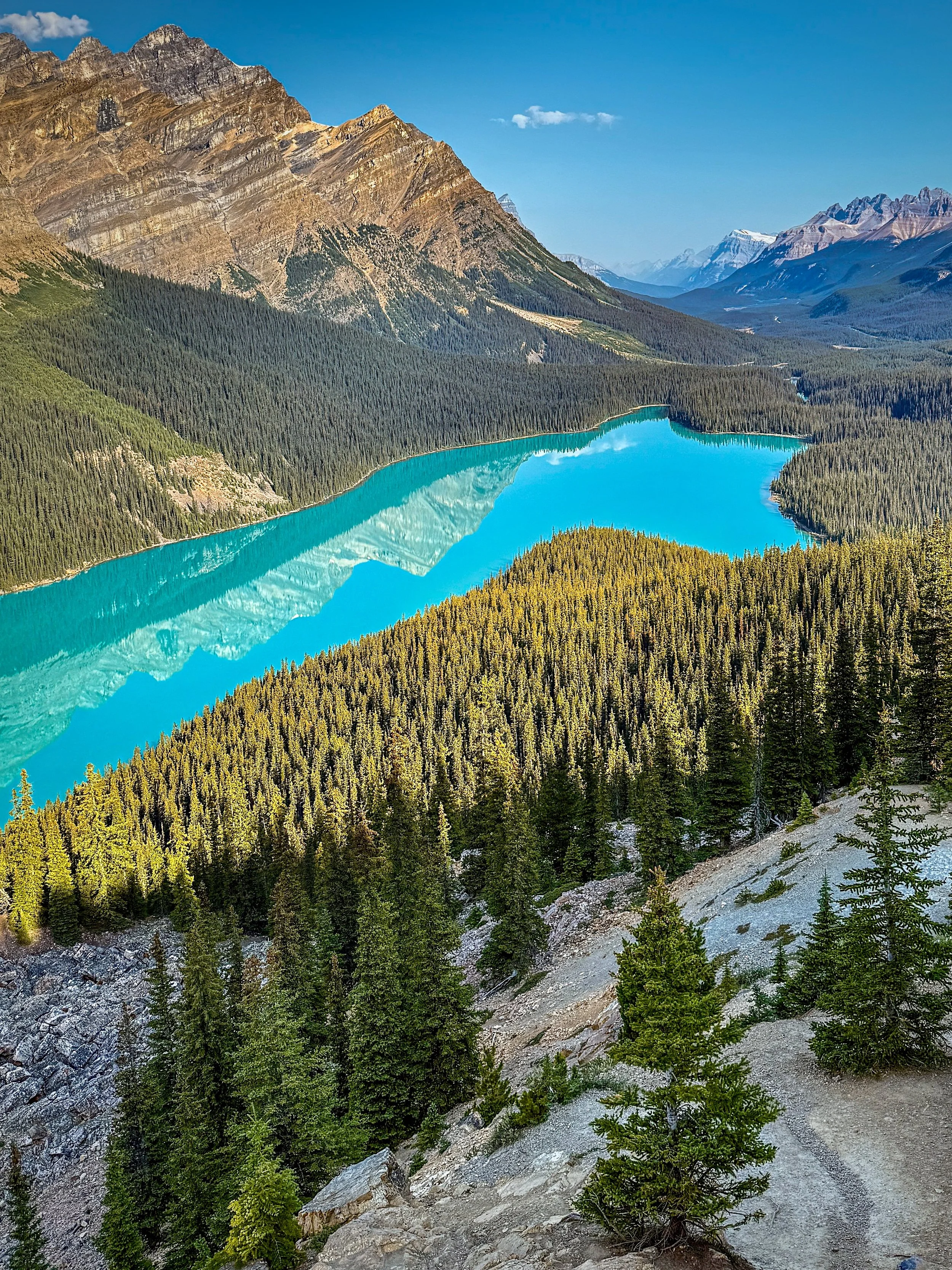
Peyto Lake, Canadian Rockies
Mountain Lakes
At first glance, Peyto Lake almost doesn't look real.
Its brilliant turquoise water appears almost too vibrant, as though someone spilled paint across the Canadian Rockies. But this breathtaking color isn't a trick of light or a camera filter. It's the work of mountains, glaciers, and time.
The secret lies in something surprisingly small: glacial sediment, often called rock flour.
Thousands of years ago, glaciers began carving their way through the surrounding mountains. Even today, the Peyto Glacier continues this slow, powerful process. As massive sheets of ice grind across the bedrock, they crush solid stone into particles so fine they resemble flour. During the warmer months, melting snow and glacier ice carry these tiny mineral fragments into Peyto Lake.
Once suspended in the crystal-clear water, the sediment becomes nature's artist.
The microscopic particles scatter sunlight in a unique way. Blue and green wavelengths are reflected back toward our eyes, while other colors are absorbed. The result is the lake's unforgettable turquoise glow—a color that can shift from soft aquamarine to brilliant sapphire depending on the season, weather, sunlight, and the amount of glacial sediment entering the lake.
Ironically, the lake's remarkable clarity comes from millions of tiny floating particles.
The color is often most vivid during midsummer, when warmer temperatures accelerate glacier melt and more mineral-rich sediment flows into the lake. As winter approaches and meltwater slows, the lake gradually becomes darker and deeper in tone.
Every season tells a different story.
But the beauty of Peyto Lake carries another message as well.
The glaciers that create this stunning landscape are changing. As global temperatures rise, many glaciers throughout the Canadian Rockies are shrinking. Scientists continue to study how these changes may affect the amount of sediment entering alpine lakes, the timing of seasonal runoff, and ultimately the brilliant colors that have captivated visitors for generations.
Peyto Lake represents the importance of protecting wild places. It serves as a reminder of the interconnected relationship between glaciers, water, forests, wildlife, and the people who cherish these places. The turquoise water is more than beautiful, it's evidence of an active landscape, one that is constantly shaping and reshaping itself.
Sometimes the most beautiful masterpieces aren't painted by human hands.
Sometimes, they're painted by glaciers.